|
Welcome to the Author Digest, January 2026 We hope you find it helpful. This digest goes out to all active Cochrane authors and will continue to be sent to authors who are opted in. Please review your communication preferences in your Cochrane Account and ensure you are opted in to communications.
|
|
|
|
|
|
Contents Word limits: What you need to know
Updated RevMan features
2025 Key editorial and production highlights
A day with... the Cochrane Co-production Methods Group
Methods Support Unit web clinic
Automation (AI) in Covidence
Top tips for Cochrane authors
|
|
|
|
|
1. Word limits: What you need to know
|
|
|
As part of our commitment to making reviews and protocols more focused and impactful, the new word limits are almost here. Here’s what you need to keep in mind: Reviews and updates will have a maximum of 12,000 words.
Protocols will have a limit of 6,000 words. These limits will apply to all new submissions from July 1, 2026. Manuscripts exceeding these limits from July onwards will not be able to be submitted. Start planning It is important to plan the write up of your review as early in the process as you can. Even if you’re planning to submit before June 30, check your word count now and make early adjustments. This will help avoid last-minute surprises and ensure your work meets the new requirements. To help you prepare, RevMan will soon introduce warnings triggered at 10,000 words for reviews and updates, and 5,000 words for protocols. These warnings should also serve reminder that post-submission revisions must also stay within the word limit. So, avoid maxing out the limit at submission – leave room for edits!If you’re planning an update of an existing review that exceeds the new word limit, you may need to edit the review to bring it under 12,000 words: when planning your update, think carefully about the scope as well as word count. The updating framework can help shape the approach you take, keeping you focused on synthesizing evidence to address the most important question. Author guidance We’re developing resources to help you write focused, structured, and concise reviews without losing clarity or completeness. Want to help shape this guidance? We’re looking for volunteer authors to join a focus group! If you are interested, please email editorinchief@cochrane.org with the subject line “Word limits: Author focus group”.
|
|
|
|
|
2. Updated RevMan features
|
|
|
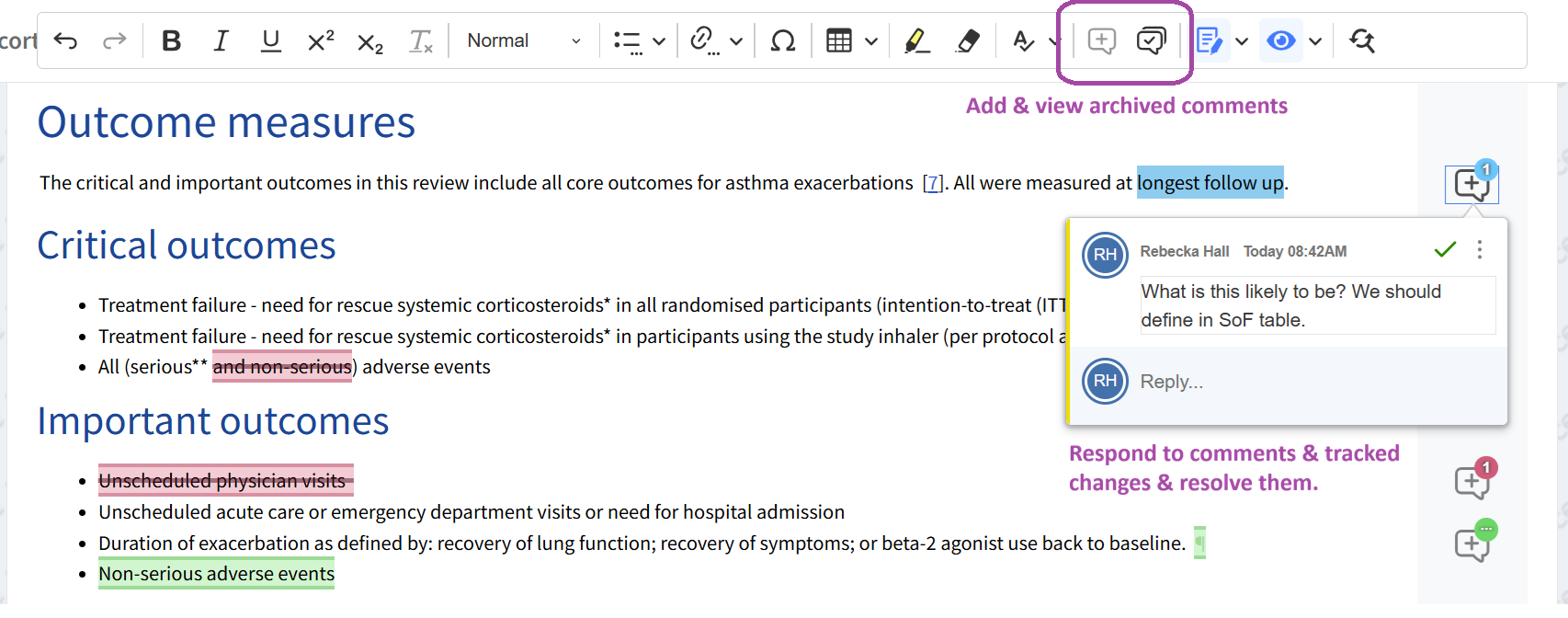
Some key features have been updated in RevMan in January! Inline commenting is now available for all Cochrane protocols, reviews, and updates, making it easier to collaborate with co-authors and Cochrane group staff. All comments should be resolved before downloading submission files, as active comments are moved to the Comments archive when taking this action.
Upgraded reference import to make workflow smoother and faster. Now, you can:
- Map references to studies easily;
- Get more complete reference data;
- Import reasons for exclusion from Covidence; and
- Have automatic styling of references to the Cochrane Style Guide. Learn more in the RevMan Knowledge Base, and reach out to Cochrane Support with any feedback on these new features.
|
|
|
|
|
3. 2025 Key editorial and production highlights
|
|
|
2025 was a year of substantial gains in Cochrane’s editorial and production performance. Improvements across turnaround times, workload management, and publication volume reflect the impact of process enhancements introduced over the past 18 months. Proposals & Submissions
- Received 539 proposals, with 255 accepted.
- Processed 532 new submissions, up from 468 in 2024.2026-2027.Editorial Efficiency
- Median time to first decision fell to 16.4 weeks, a significant improvement from 23.3 weeks in 2024.
- Time from first to final decision showed further efficiency gains, driven largely by reduced editor handling time.
- Acceptance rate reached 79%, with 501 decisions issued—representing a 10% increase from 2024. Production Performance
- All production turnaround times improved significantly: - Copyeditor assignment time reduced by 87% (overall median: 3.5 days). - Acceptance-to-proofreading time shortened by 54% (overall median: 30 days). - Total publications rose to 427 (up by 42 from 2024), including 132 protocols, 190 reviews, and 105 updates.
|
|
|
|
|
4. A day with... the Cochrane Co-Production Methods Group
|
|
|
Are you interested in learning about co-production for evidence synthesis? Would you like to know more about the Cochrane Co-Production Methods Group? If so, you can attend a series of webinars on 24 February (14:00 - 17:00 UTC) to hear from the Co-Production Methods Group co-convenors and guest speakers about these topics. You can register for the event here and submit questions for speakers and the Group's co-convenors in advance. For other 'A day with a Methods Group webinars', visit this page.
|
|
|
|
|
5. Methods Support Unit web clinics
|
|
|
The next two MSU web clinics are open for sign-up. The February clinic focuses on a new risk of bias tool for network meta-analysis. The March clinic focuses on INSPECT-SR - a tool for assessing the trustworthiness of randomised controlled trials. Don’t forget - if you sign-up, you will automatically be sent a recording of the session afterwards. Introduction to a new risk of bias tool for network meta-analysis: Thursday 12 February: 4pm UTC (check time in your time zone)
INSPECT-SR: A tool for assessing trustworthiness of randomised controlled trials: Thursday 19 March: 9am UTC (check time in your time zone)
|
|
|
|
|
6. Curious about Covidence's approach to AI?
|
|
|
Covidence’s approach to automation puts review integrity first, helping researchers balance efficiency with methodological rigor. Whether you’re considering AI support or already using it, Covidence’s updated guidance walks you through how to plan, assess, and transparently report the use of automation in your review. We have information on how to determine if Covidence’s AI tools are the right fit for your topic and provide standard text needed to report its use in compliance with Cochrane and RAISE guidelines. Read more about automation (AI) in Covidence here.
|
|
|
|
|
7. Top tips for Cochrane Authors
|
|
|
|
|
|
When you're getting ready to submit your protocol or review to Cochrane, make sure you read through and fill out a pre-submission checklist. The checklists contain important details for your manuscript. Learn more here.
|
|
|
|
|
|
|
|
|