|
Welcome to the Author Digest, June 2025 We hope you find it helpful. This digest goes out to all active Cochrane authors and will continue to be sent to authors who are opted in. Please review your communication preferences in your Cochrane Account and ensure you are opted in to communications.
|
|
|
|
|
|
Contents Guidance for Cochrane authors is now easier to find
Adding ORCID iDs in Editorial Manager
Understanding expectations for evidence synthesis when using AI compared to current best practice
New and updated Responsible AI use in Evidence Synthesis (RAISE) recommendations and guidance
Upcoming Methods Support Unit web clinics
Reminder: Starting 1 July, all new protocols should use the new random-effects methods in RevMan
Recent update to the intervention review template
Clarification on how to acknowledge supporting groups in your reviews
Covidence
Top tips for Cochrane authors
|
|
|
|
|
1. Guidance for Cochrane authors is now easier to find
|
|
|
We’re excited to announce the launch of the new Cochrane website! We’ve worked hard to make the website more intuitive for our community and to more clearly present Cochrane to the world. One of the major changes is that you can now find all the information you need to write a Cochrane review or protocol in one place! Take a look at our ‘For authors’ section to see what’s new.
|
|
|
|
|
2. Adding ORCID iDs in Editorial Manager
|
|
|
By adding your ORCID iD in Editorial Manager, your unique researcher identity will appear alongside your name on your published review on the Cochrane Library.
This ensures your research identity is fully visible and enhances transparency and trust in the research we publish.
Log in to Editorial Manager and link your ORCID iD today—so your contributions are visible, verifiable, and valued.
|
|
|
|
|
3. Understanding expectations for evidence synthesis when using AI compared to current best practice
|
|
|
The evidence synthesis field needs community-based best practices to facilitate the use of automation and AI in evidence synthesis. One area of uncertainty is how 'correct' should evidence synthesis be. We do not currently have consensus on how correct it should be with current best practice (i.e. humans only), how this changes if we add AI, what an acceptable impact of errors might be, and whether this changes for different types of evidence synthesis. The Wellcome-funded DESTinY consortium, of which Cochrane is a partner, has therefore launched a survey to better understand community expectations, which will inform future work and how the next generation of evidence synthesis tools driven by AI are built and evaluated. We welcome feedback from anyone interested in this topic via this survey. Open until 2 July and takes approx. 35 minutes.
|
|
|
|
|
4. New and updated Responsible AI use in Evidence Synthesis (RAISE) recommendations and guidance
|
|
|
RAISE is now a three-paper collection available on OSF, including: - RAISE 1 with recommendations for practice for the main roles in the evidence synthesis ecosystem to enhance collaboration and communication for the transparent & reliable use of AI in evidence synthesis.
- RAISE 2 with guidance on building and evaluating AI evidence synthesis tools, which focuses on determining if an AI tool does what it claims to do to an acceptable standard, including how to build and validate AI tools, conduct evaluations to build a cumulative evidence base, including performance metrics to consider, & report evaluations.
- RAISE 3 with guidance on selecting and using AI evidence synthesis tools, which focuses on understanding whether an AI tool can be used for a specific evidence synthesis, including how to assess, select & use an AI tool, including ethical, legal and regulatory considerations, and the current state of AI tools for evidence synthesis.
This is a joint initiative with individuals from across 30+ organizations, including Cochrane. Anyone interested in using AI in their evidence synthesis should be familiar with these recommendations and the associated guidance. If you would like to learn more including practical tips for applying RAISE as a systematic review author, we recommend you catch up on the recent Cochrane Learning Live webinar on recommendations and guidance on responsible AI in evidence synthesis.
|
|
|
|
|
|
The next two MSU web clinics are open for sign-up. These clinics will have a Q&A format - we’ll be asking for your questions in advance and discussing them in the session. Don’t forget - if you sign-up, you will automatically be sent a recording of the session afterwards Network Meta-Analysis (NMA) Q&A. Thursday 10th July 8am UTC (check in your time zone) Risk of Bias 2 (RoB 2) Q&A. Thursday 11th September 8am UTC (check in your time zone)
|
|
|
|
|
6. Reminder: Starting 1 July, all new protocols should use the new random-effects methods in RevMan
|
|
|
Cochrane is committed to providing users with the most up-to-date methodologies to produce more accurate and robust research results. In January, following recommendations of the Cochrane Statistical Methods Group, RevMan introduced a new set of statistical methods for use with the random-effects models in systematic reviews of interventions. Starting 1 July, all new submissions of protocols should use these methods. Please note, if you have already submitted your protocol, review, or update, and are currently revising following editorial and peer review comments, you should not change your statistical methods unless asked to do so. The following resources provide more information about these methods: If you have any questions, please contact Cochrane Support.
|
|
|
|
|
7. Recent update to the intervention review template
|
|
|
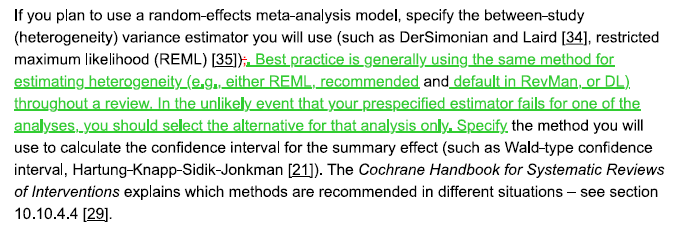
Cochrane's intervention review template contains essential guidance on conducting your review and reporting your findings. The intervention review template is updated periodically to ensure authors have clear and current guidance on best practice for Cochrane reviews. We therefore advise that authors always open the template as a practice review in RevMan to ensure you are always viewing the latest version. For access to, and more details on using, the template, visit the RevMan Knowledge Base. The following sections of the template have been updated in June 2025: - 'methods > data collection and analysis > investigation of heterogeneity and subgroup analysis': updated to advise authors to report the inability to perform subgroup analyses due to insufficient studies or information in this section rather than at the beginning of the 'methods'.
- 'methods > synthesis methods': updated to recommend authors to use the same methods for heterogeneity estimation (REML, recommended and default in RevMan, or DL) throughout a review.
See template changes in the images below.
|
|
|
|
|
8. Clarification on how to acknowledge supporting groups in your reviews
|
|
|
Cochrane groups supporting authors can now be acknowledged in the byline using the phrase “supported by the Cochrane [Group Name]” via RevMan’s group attribution field. Authors should request group acknowledgement via their Cochrane Group contact or Unit Lead, or by contacting Cochrane Support. See more details in the RevMan Knowledge Base.
|
|
|
|
|
|
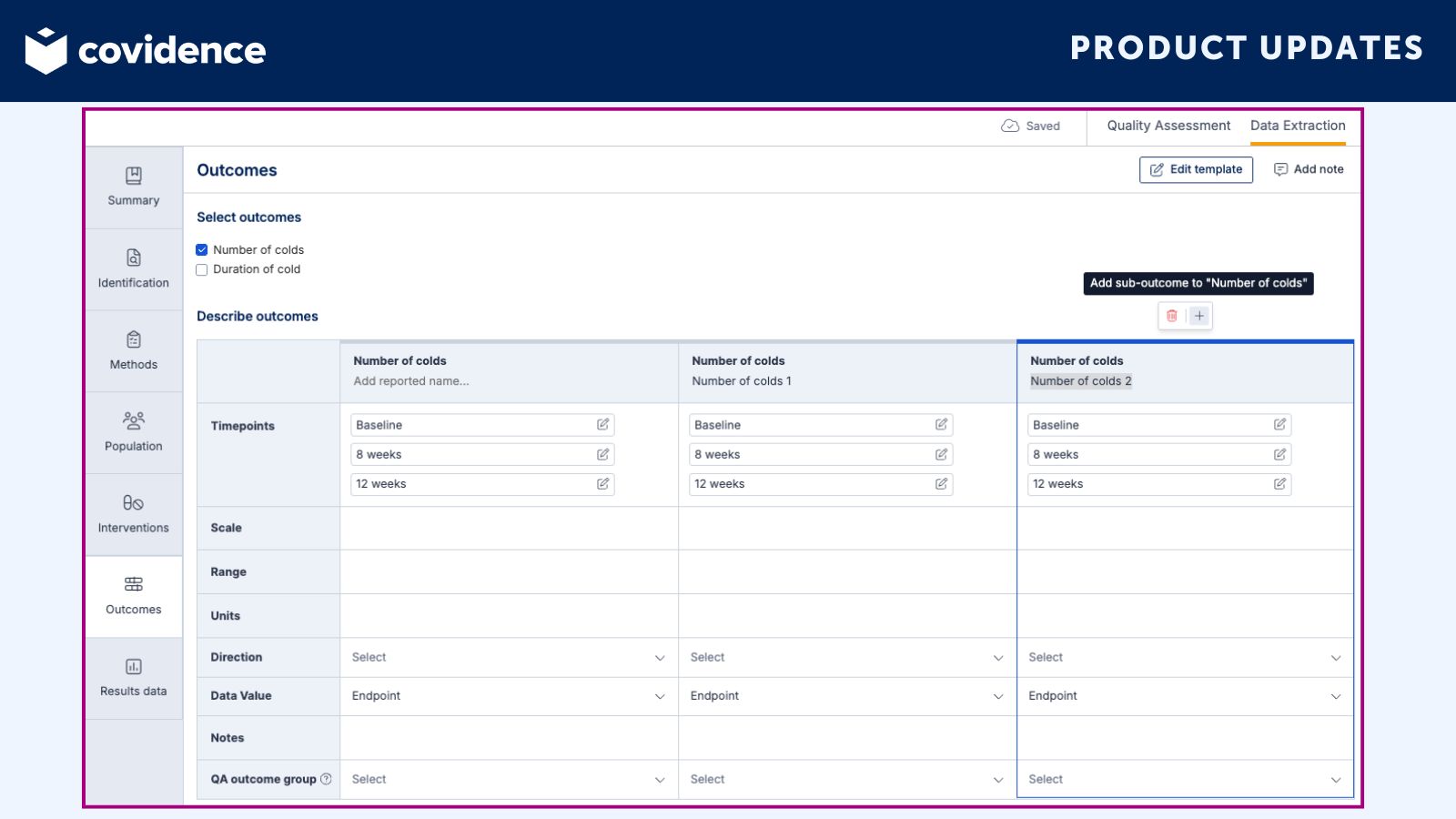
In Extraction 1, you can now add multiple sub-outcomes within a study — all while maintaining a link to your template-defined outcomes. This means you can easily setup the template upfront and accurately capture outcome data as reported for each study. Try it out and let us know what you think.
|
|
|
|
|
10. Top tips for Cochrane Authors
|
|
|
|
|
|
When you're submitting your protocol, review, or update to Cochrane's Central Editorial Service, please do not change the file names on the submission files that are generated in RevMan! These file names contain key information that ensure your submission is processed correctly in our systems. You will be asked to re-submit your files if submission file names have been changed. Full instructions on how to correctly submit are available in the Editorial Manager Knowledge Base.
|
|
|
|
|
|
|