|
Welcome to the Author Digest, May 2026 We hope you find it helpful. This digest goes out to all active Cochrane authors and will continue to be sent to authors who are opted in. Please review your communication preferences in your Cochrane Account and ensure you are opted in to communications.
|
|
|
|
|
|
Contents
1. Call for RevMan beta testers
2. Annual awards now open
3. Pilot the updated PRISMA-NMA Reporting Guideline
4. Reminder: upcoming webinar, word limits will be in place from 1 July 2026
5. Reminder: upcoming deadline 1 July 2026 - Use of new random-effects methods for all new submissions
6. Covidence
7. Top tips
|
|
|
|
|
1. Call for RevMan beta testers
|
|
|
Cochrane will soon be rolling out new functionality allowing users to create Summary of Findings tables directly in RevMan, rather than needing to use a third party tool. We are looking for RevMan users to take part in beta testing of this functionality, to ensure it best meets their needs.
If you would like to be involved in the beta testing, please complete this form.
|
|
|
|
|
2. Annual awards now open
|
|
|
Cochrane’s annual awards are now open for nominations. We invite you to highlight outstanding contributions across our global community for the following awards: Submissions are now open and run until 27 July 2026. Prize winners will be notified mid-October. Submit your nominations now!
|
|
|
|
|
3. Pilot the updated PRISMA-NMA Reporting Guideline
|
|
|
Authors, reviewers, journal editors, policymakers, methodologists, statisticians, clinicians, and others involved in conducting or using network meta-analyses (NMA) are invited to pilot test the updated Preferred Reporting Items for Systematic reviews and Meta-Analyses (PRISMA) reporting guidelines for NMA (PRISMA-NMA). Participants can apply the checklist to their own NMAs or to published examples and provide feedback on clarity and usability of the checklist.
If you are interested in providing feedback, please contact Mallory Drysdale to be included in the distribution list. Participants will be contacted at the end of May 2026 to pilot the checklist between 1 June and 26 June.
|
|
|
|
|
4. Reminder: upcoming webinar, word limits will be in place from 1 July 2026
|
|
|
From 1 July, Cochrane will be introducing word limits for our reviews, updates, and protocols, to help keep our evidence focused, concise, and more accessible for readers. We are holding two webinars to support authors in writing more focused and concise reviews. - Catch up on the first webinar, which explores how tools within RevMan Web can aid in the planning and structuring of your review to manage scope.
- Register for the second webinar, happening on 11 June, which offers pragmatic, experience‑based guidance on preparing a Cochrane Review that is focused, readable, and fully compliant with MECIR standards without unnecessary length
You can find out more about why we are introducing word limits and what you need to know here.
|
|
|
|
|
5. Reminder: upcoming deadline 1 July 2026 - Use of new random-effects methods for all new submissions
|
|
|
In January of 2025, following the recommendations of the Cochrane Statistical Methods Group, RevMan introduced a new set of statistical methods for use with the random-effects model in systematic reviews of interventions. Last July, all new protocols for reviews of interventions adopted these methods. This year, as of 1 July 2026, all new protocol, review, and update submission should adopt the recommended methods in the synthesis of data when using the random-effects model. If you are planning a submission after this date and plan to use the random-effects model for your analyses, please be sure to check your methods section and analyses ahead of submission! To learn more about these methods and access further resources, please click here and visit the RevMan Knowledge Base.
|
|
|
|
|
6. Extraction suggestions now available for Cochrane reviews in Covidence
|
|
|
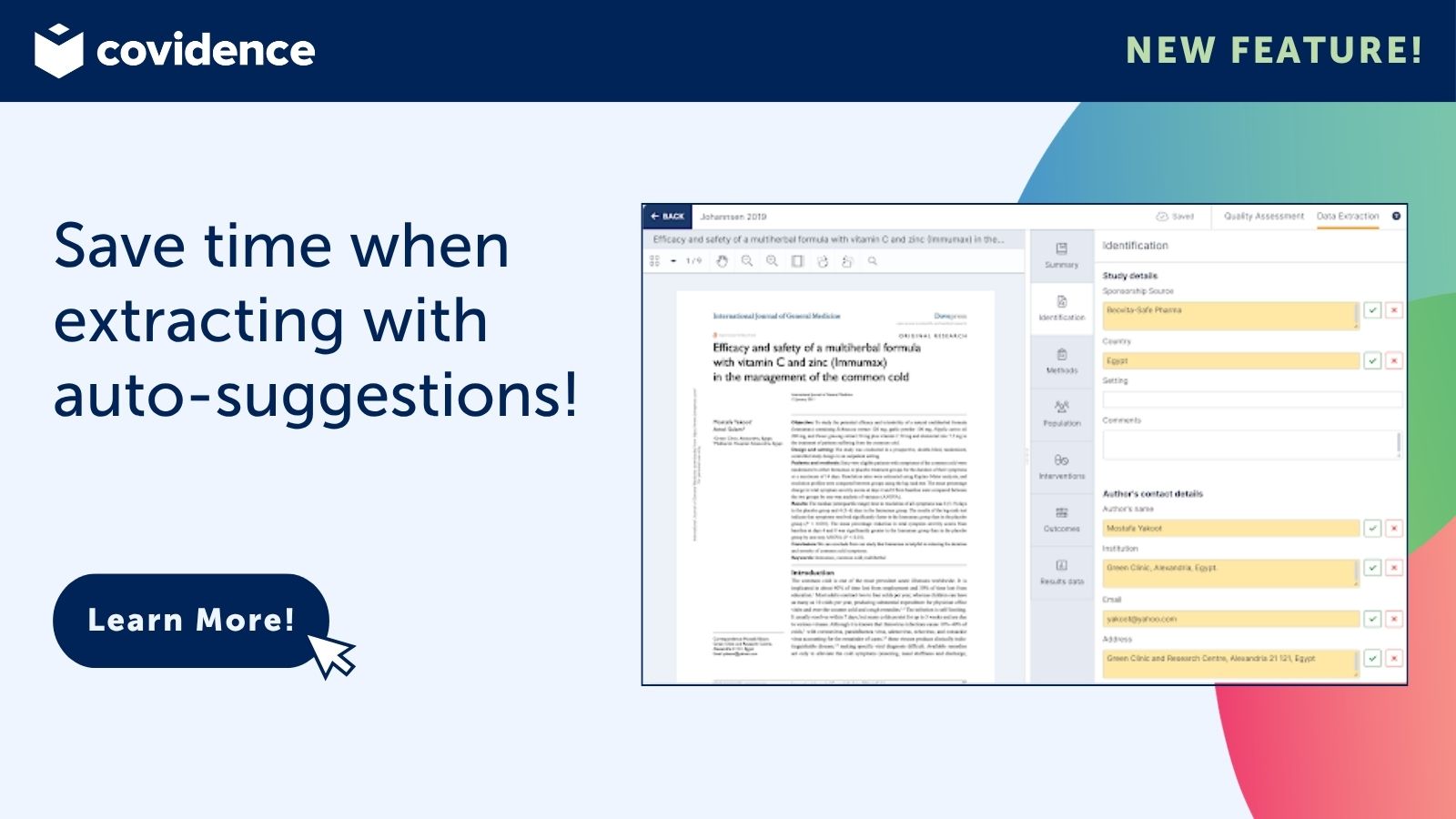
Cochrane reviews in Covidence can now use extraction suggestions to help speed up study extraction. Suggestions are currently available for identification fields, with more fields coming soon. Extractors can easily accept or reject these suggestions, saving time and effort, while keeping extractors in full-control. 👉 Learn more in our knowledge base article, including model evaluations and how to report use of this feature in line with RAISE guidelines.
|
|
|
|
|
7. Top tips for Cochrane Authors
|
|
|
|
|
|
When you're submitting your protocol, review, or update to Cochrane's Central Editorial Service, please do not change the file names on the submission files that are generated in RevMan! These file names contain key information that ensure your submission is processed correctly in our systems. You will be asked to re-submit your files if submission file names have been changed.
|
|
|
|
|
|
|
|
|