|
Welcome to the Author Digest, August 2026 We hope you find it helpful. This digest goes out to all active Cochrane authors and will continue to be sent to authors who are opted in. Please review your communication preferences in your Cochrane Account and ensure you are opted in to communications.
|
|
|
|
|
|
Contents 1. 2026 submission cut-off period
2. Do you know of a priority review topic looking for an author team?
3. Update: Data Sharing policy
4. 2026 Methods Symposium: Advancing methods for the responsible use of AI in evidence synthesis
5. Upcoming Methods Support Unit web clinic
6. New in RevMan
7. Recent update to the Cochrane review template: reporting excluded studies
8. Covidence: Spot research integrity concerns earlier
9. Top tips: ORCiD IDs and publication on the Cochrane Library
|
|
|
|
|
1. 2026 submission cut-off period
|
|
|
To help manage year‑end workloads and submission volumes more effectively, the Central Editorial Service will once again apply an annual submission cut‑off for new submissions (this does not apply to proposals or revisions). This approach reflects standard practice in publishing, recognising the reduced availability of both internal teams and external contributors (e.g., peer reviewers) during the final weeks of the year. As a result, submissions received during this period are often not progressed until the new year. Key Dates: - Final submission date (via Editorial Manager): Monday, 30 November 2026
- Submissions reopen: Monday, 4 January 2027
We kindly ask authors to plan their submissions accordingly. If you have a valid reason to submit during the cut‑off period, please contact support@cochrane.org. Requests will be considered on a case‑by‑case basis by Cochrane’s Editorial team. Thank you for your understanding and cooperation.
|
|
|
|
|
2. Do you know of a priority review topic looking for an author team?
|
|
|
We're gathering information on review titles that have emerged from priority-setting processes, as well as existing priority Cochrane review titles that currently do not have author teams. This information will help us promote opportunities to the wider community, making it easier to connect important review topics with interested author teams through targeted author calls like this one. If you know of any relevant titles or would like to discuss further, please get in touch with Roses Parker, Commissioning Editor.
|
|
|
|
|
3. Update: Data Sharing policy
|
|
|
|
|
4. 2026 Methods Symposium: Advancing methods for the responsible use of AI in evidence synthesis
|
|
|
|
|
5. Upcoming Methods Support Unit web clinic
|
|
|
The next MSU web clinic is open for sign-up. The October clinic focuses on core outcome sets. Don’t forget - if you sign-up, you will automatically be sent a recording of the session afterwards. Measuring what matters: practical guidance on core outcome sets for systematic review authors: Thursday 1 October: 8am UTC (check time in your time zone)
|
|
|
|
|
|
Dynamic summary of findings tables are moving into a new phase of beta testing. You no longer need to ask us to enable the feature to use it. The RevMan development team is very much looking forward to get your input. So try it out and sign up to share feedback using this form, send an e-mail or book a time slot to chat with us. We're adding a new field to studies in RevMan so you can mark whether a study is randomized (RCT) or non-randomized (NRSI). This will help ensure the right methods are used during analysis and when assessing certainty of the evidence. Dynamic summary of findings will automatically show number of studies that are RCTs or NRSI. If any included studies haven't been categorized, you'll see a validation warning with a quick-fix option. RevMan will suggest an allocation method for each study based on its methods study characteristics, so you can review and confirm them all in one go rather than doing it one by one. Provisional release date is 3 September.
|
|
|
|
|
7. Recent update to the Cochrane review template: reporting excluded studies
|
|
|
Cochrane's review templates contains essential guidance on conducting your review and reporting your findings. Review templates are updated periodically to ensure authors have clear and current guidance on best practice for Cochrane reviews. We therefore advise that authors always open the template as a practice review in RevMan to ensure you are always viewing the latest version. This month, the review templates have been updated based on community feedback with clearer guidance for reporting excluded studies.
|
|
|
|
|
8. Covidence: Spot research integrity concerns earlier
|
|
|
|
|
|
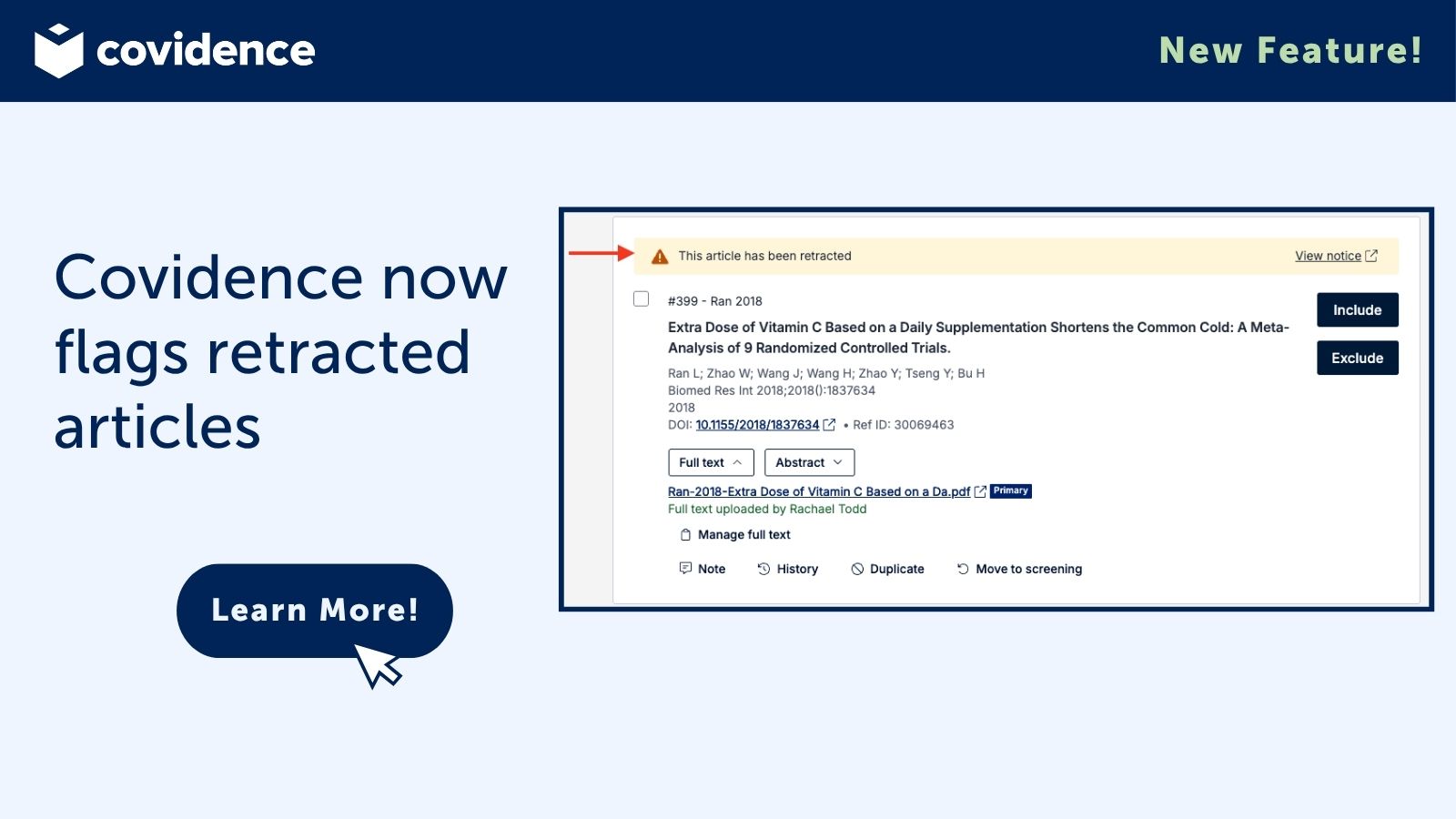
Covidence now alerts you if a study has been retracted, has an expression of concern, or is associated with a problematic journal. Alerts appear directly within your review, helping you identify potential research integrity issues before making inclusion or extraction decisions. Research integrity alerts are refreshed every 12 hours to help keep your review up to date. Learn more about this new feature here.
|
|
|
|
|
9. Top tips for Cochrane Authors
|
|
|
|
|
|
When submitting your review in Editorial Manager, the corresponding author must include all co-author ORCID IDs if they wish them to be published. Editorial Manager will not pull ORCID IDs from co-author's Editorial Manager accounts. On the Cochrane Library, ORCID IDs on the Cochrane Library will publish as links to the researcher's profile.
|
|
|
|
|
|
|