View Email as a Web Page

Trusted evidence. Informed decisions. Better health.

  Issue 10 | November 2021 (next issue January 2022)

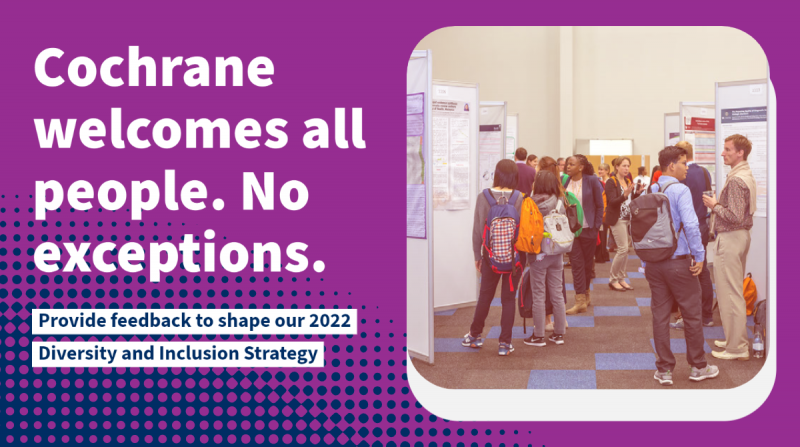
Cochrane launches a new focus on diversity and inclusion

Cochrane wants to welcome people, no matter who they are or where they live. This is an opportunity to reflect on your experiences of diversity and inclusion in Cochrane. Please take a few moments to complete a short survey and let us know if you are interested in attending a small group meeting to share your experiences. Follow this link for more details.

News from our members

Robin Vernooij, Post-doctoral researcher at University Medical Center Utrecht

Subgroup analyses are a useful tool to investigate the possibility of differing treatment effects between subgroups of patients with certain characteristics (e.g., women vs men, old vs young, more versus less severe disease status). Nevertheless, its methodology and reporting are not always adequately used. Hence, criteria for assessing the credibility of subgroup analyses, nicely summarized in a formal Instrument for Assessing the Credibility of Effect Modification Analyses (ICEMAN), include investigator postulation of a priori hypotheses with a specified direction; support from prior evidence; a low likelihood that chance explains the apparent subgroup effect; and only testing a small number of subgroup hypotheses. In this mini-review, we explore the common pitfalls of subgroup analyses.

Have you recently published a paper, presented at a conference, written a blog, or done something amazing that you want to share? Send us a brief description, your Twitter handle, and a headshot (if you wish) to ecp@ochrane.org to be featured in our upcoming newsletter.

Trainings and events

Upcoming opportunities

📢 MSc Health Data Science at the University of Liverpool. Applications for the Autumn 2022 intake are now open. The programme will expose you to core health research, statistics and computer science modules, with the opportunity to obtain specialised knowledge along a statistics track, computer science track, or a combination.  More information can be found here. 


📢 The ALBA Network is holding a panel discussion on challenges and opportunities for neuroscientists in the Middle East & North Africa region. Register and join the discussion on Friday 3 December 2021.


📢 In Norway? Great opportunity for 2 full-time researchers in effect studies and 1 full time researcher/(bio-)statistician with The Centre for Epidemic Intervention Research. Check out more here.


📢 Have you developed, tested or combined RStats packages or tools in evidence synthesis or meta-analysis? Why not submit an abstract to ESMARConf2022, a free conference on evidence synthesis and meta-analysis in R happening in February 2022!?


📢 The American Academy of Pediatrics’ International Community Access to Child Health is offering a new cycle of funding for health workers in low- and lower-middle income countries who are trying to implement simple but sustainable efforts that improve child health. Check out more details and apply.


📢 Four stipends are available for travel to the Medicine and Time conference, which takes place in Germany, June 7–8, 2022. Slease submit an application letter consisting of a statement of motivation and a brief description of academic background to gardar.arnason@uni-tuebingen.de. Deadline for applications is January 1, 2022.

Training resources

📢 New videos from the Cochrane Learning Live and Qualitative Evidence Synthesis (QES) webinar series. Question formulation and searching for qualitative evidence. Webinar recording freely available here.


📢 The fifth annual Cochrane Methods report compiled by the Methods Team in the Central Executive Team provides an overview of the key methodological activities in Cochrane over the past year. You can catch-up on everything here.


📢 Have you seen Cochrane's International Patient and Public Involvement (PPI) Network: Learning Live webinar series? All webinar recordings are available in their archive here.


📢 Cochrane Connects: Recently the Cochrane Community gathered together to hear updates on Cochrane's approach to Open Access, celebrate the 2021 Prize & Awards winners, & hear from representatives of the Cochrane Climate-Health Working Group. Watch the recordings!


📢 Evidently Cochrane: Karen Morley reflects on her experience of becoming a consumer author on a Cochrane Review, using her lived experience of Obsessive Compulsive Disorder (OCD) and considers the questions it raised for her about Public Involvement in research (PI). Karen has also drawn all the illustrations in this blog.


📢 Evidence Essentials from Cochrane training is a free online introduction to health evidence and how to use it to make informed health choices.  


📢 You can check the latest numbers of COVID-19 studies, systematic reviews & RCTs from the National COVID-19 Clinical Evidence Taskforce in Australia. Access all their clinical recommendations and flowcharts here.


Learning Live is a series of monthly webinars open to everyone and an archive of previous webinars. Upcoming webinar:

- Selecting studies and assessing methodological limitations *QES webinar series* (13 December)

- Framework and Best Fit Framework Synthesis *QES webinar series* (20 January)

Cochrane Starter Pack

Sign up for a Cochrane account and then explore all the amazing ways to get involved

TaskExchange - Use your skills to help authors complete reviews

Cochrane Crowd - Volunteer to help categorise and summarise healthcare evidence

Online learning - Resources relevant to systematic reviews and evidence-based medicine

Interactive Learning (Cochrane account required) - how to conduct a systematic review

Evidence Essentials (free but Cochrane account required) - introduction to health evidence

Learning events - find information about upcoming training (in-person and online)

Copyright © 2021 Cochrane, All rights reserved.
Registered in England as a company limited by guarantee No. 03044323 Charity Number 1045921. Registered office: St Albans House 57-59 Haymarket London, SW1Y 4QX United Kingdom


To update your communication preferences please visit your Cochrane Account.
If you have any questions please email support@cochrane.org  

This page uses cookies to offer a better browsing experience, analyze site usage, personalize content, and assist in our marketing efforts. You can change your settings by clicking on "Cookie Preferences."

Cookie Preferences   ▼

This is your setting for either accepting or rejecting cookies on our site. Select to either accept or reject cookies.